
A nature-based bio-engine, instrumented for industrial standards
Our proprietary bio-engine leverages the metabolic synergy of the Black Soldier Fly larva (Hermetia illucens) and its rich gut microbiome to transform environmental hazards into high-value ecological assets.

Hydrocarbon degradation & waste upcycling
Metabolic Bio-Augmentation
BSFL digest up to twice their body weight daily in organic substrates. Their digestive tract hosts hydrocarbon-clastic bacterial strains (Pseudomonas, Rhodococcus, Bacillus and Acinetobacter spp.) capable of synthesizing extracellular lipases and oxygenase enzymes.
Hydrocarbon Cleavage
When inoculated into hydrocarbon-laden environments, BSFL frass — rich in active enzymes, bio-surfactants and high-density microbial populations — secretes enzymes that break long-chain alkanes and polycyclic aromatic hydrocarbons (PAHs) into bio-available compounds.
Circular Resource Loop
Simultaneously, organic municipal and agricultural wastes are upcycled into nutrient-dense insect biomass (rich in proteins and lipids for animal feed) and stabilized, bio-active biofertilizer, reducing waste-to-landfill metrics to zero.
Five stages, one closed loop
~4 days
Population cycling
Gravid females oviposit ~500–900 eggs in dry crevices adjacent to the substrate. Controlled humidity and temperature in the rearing system set colony throughput for the entire bio-engine.
12–18 days
Bio-conversion + hydrocarbon degradation
The active phase. Larvae consume up to twice their body weight daily, reducing organic waste volume by 80% while their gut microbiome enriches the frass with hydrocarbon-clastic bacteria, lipases and bio-surfactants.
~7 days
Harvest window
Larvae empty their gut and self-migrate out of the substrate — enabling automated, energy-free separation of biomass from frass. Prepupae are diverted into BSF-Pro protein feed processing.
~14 days
Colony renewal
A non-feeding stage held in the climate-controlled dark room. A fixed fraction of each cohort is reserved here to guarantee uninterrupted breeding stock for continuous field supply.
5–8 days
Reproduction
Adults do not feed and are not vectors of disease. They mate in lighted love-cages, close the loop and return the system to the egg stage — a fully closed, zero-input population cycle.
Bridging biological remediation with operational standards
The platform integrates an AI-driven monitoring and analytics engine designed specifically for marginal field operators and environmental asset managers.
Real-Time Degradation Kinetics
On-site IoT telemetry arrays measure soil moisture, temperature, dissolved oxygen and microbial respiration rates. Data feeds directly into a cloud-based Machine Learning pipeline using Recurrent Neural Networks (LSTM) to predict Total Petroleum Hydrocarbon (TPH) decay curves.
Prescriptive Dosage Optimization
The AI engine dynamically calculates site-specific re-inoculation rates for BSFL frass and moisture adjustments, avoiding over-application and reducing operational expenditure (OpEx) by up to 35%.
Regulatory Compliance Reporting
Generates automated, timestamped soil health reports compliant with environmental regulatory benchmarks (EGASPIN, DPR and US EPA guidelines), providing operators with verified timelines for site release.
A.I.-enabled spill detection, trajectory & recovery monitoring tool
A four-source Bayesian probability framework that combines:
- Satellite dark patch detection score
- Vessel proximity — AIS-tracked and dark (non-broadcasting) vessels near the site
- Pipeline proximity and age-based integrity risk (pipelines beyond 45 years are flagged extreme risk)
- Environmental look-alike risk — wind speed and biogenic baseline, to reduce false positives
This produces a probability-weighted attribution across four causes — sabotage, integrity failure, vessel discharge and natural seepage — calibrated against Niger Delta historical priors (approximately 57% sabotage, 28% equipment failure, per published literature). Attribution is directly relevant to regulatory reporting obligations and tells the remediation team whether the contamination source is ongoing (requiring monitoring during remediation) or a one-off historical event.
Determining the correct downgradient location for surface and near-surface contamination pathways benefits from predictive spread modelling, not just current-state mapping.
The tool integrates NOAA’s PyGNOME — the open-source computational engine behind NOAA’s official oil spill trajectory model (WebGNOME) — combining real-time wind data (ERA5), ocean and surface current data (HYCOM, Gulf of Guinea coverage), and oil weathering properties for Niger Delta crude grades (Bonny Light, Forcados, Brass River) via NOAA’s public ADIOS Oil Database.
The output is a predicted contamination spread footprint over time — directly informing where a Bio-PRB should be sited to intercept the plume before it reaches sensitive receptors, and providing an independent satellite-derived cross-check for the hydrogeological survey.
Phase 3 methodology calls for measuring recovery by confirming “vegetation indices return to baseline greenness” — precisely what satellite vegetation monitoring is built for, and a complement to quarterly groundwater well sampling with continuous, wide-area, low-cost surface observation.
Proprietary geospatial analysis computes the Normalised Difference Vegetation Index (NDVI) over the PRB treatment area and surrounding mangrove/wetland habitat, providing a pre-treatment baseline vegetation health map, continuous automated tracking throughout the 3–6 month treatment window and beyond, and independent satellite-dated evidence demonstrating that remediation has measurably restored ecological health — not just reduced subsurface contaminant concentrations.
Nature's bio-remedial engine
BSFL frass is the nutrient-dense, microbially active byproduct composed of digested organic matter, larval excretions and shed exuviae generated during the bioconversion process of Hermetia illucens. Positioned at the intersection of soil remediation and sustainable agriculture, it serves as both a powerful biological catalyst and a high-value biofertilizer.
BSFL frass acts as a natural inoculant rich in hydrocarbon-clastic microbial populations (Pseudomonas, Rhodococcus and Bacillus species). Applied to crude oil / TPH-contaminated soils, the frass secretes extracellular enzymes, lipases and natural bio-surfactants that break complex petroleum hydrocarbon chains into non-toxic organic intermediates.
Containing significant traces of chitin and chitosan from larval molts, frass stimulates native soil microbiology and triggers Systemic Acquired Resistance (SAR) in plants, boosting immunity against soil-borne pathogens and abiotic stress factors.
Rich in bio-available Nitrogen, Phosphorus and Potassium alongside essential trace minerals, frass improves soil organic matter, restores optimal carbon-to-nitrogen (C:N) balances and enhances soil water-retention capacity in degraded operational sites.
By upcycling organic municipal, agricultural and industrial processing wastes into stabilized frass, the system completely closes the nutrient loop — converting environmental pollution into a bio-restorative asset that recharges depleted soils.
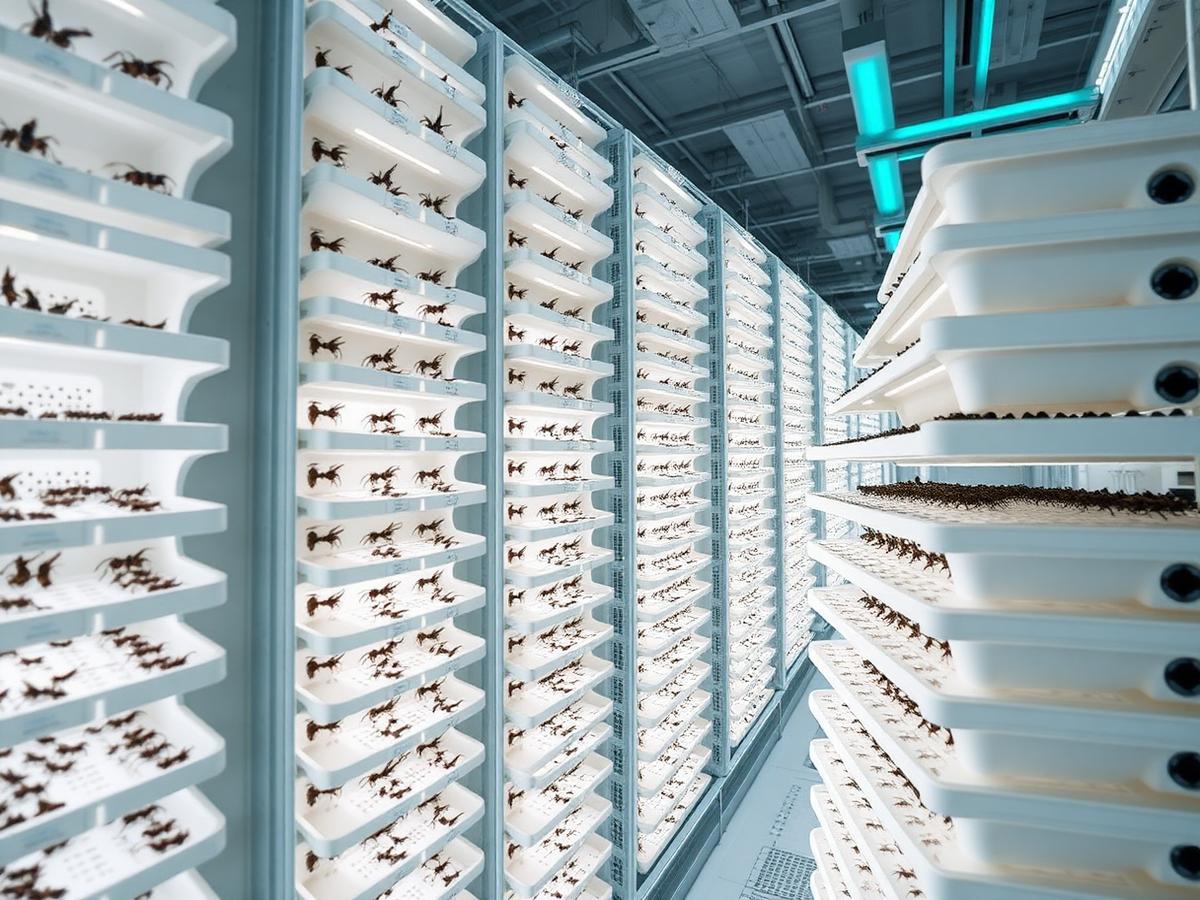
100 m² Vertical Automated Rearing System (VARS)
- 100 m² vertical automated rearing footprint delivering continuous colony output.
- Climate-controlled modular HDPE trays engineered specifically for tropical environments.
- TRL 4–5: pilot ready and field deployable for marginal field operations.